Composting as a
recognized practice
dates to at least the
early Roman era since
Pliny the Elder (AD
23-79) who refers to
compost in his writings.
Traditionally,
composting was to pile
organic materials and
let them stand for about
a year, or until the
next planting season, at
which time the materials
would be ready for soil
application. The main
advantage of this method
is that little working
time or effort is
required from the
composter and it fits in
naturally with
agricultural practices
in temperate climates.
Disadvantages (from the
modern perspective) are
that space is used for a
whole year, some
nutrients might be
leached due to exposure
to rainfall, and disease
producing organisms,
some weed, weed seeds
and insects may not be
adequately controlled.
Composting was somewhat
modernized beginning in
the 1920s in Europe as a
tool for organic
farming. The first
industrial station for
the transformation of
urban organic materials
into compost was set up
in Wels/Austria in the
year 1921. The early
personages most cited
for propounding
composting within
farming are for the
German-speaking world
Rudolf Steiner, founder
of a farming method
called biodynamics, and
Annie Francé-Harrar, who
was appointed on behalf
of the government in
Mexico
and supported the
country 1950-1958 to set
up a large humus
organization in the
fight against erosion
and soil degradation. In
the English-speaking
world it was Sir Albert
Howard who worked
extensively in India on
sustainable practices
and Lady Eve Balfour who
was a huge proponent of
composting. Composting
was imported to America
by various followers of
these early European
movements in the form of
persons such as J.I.
Rodale (founder of
Rodale Organic
Gardening), E.E.
Pfeiffer (who developed
scientific practices in
biodynamic farming),
Paul Keene (founder of
Walnut Acres in
Pennsylvania), and Scott
and Helen Nearing (who
inspired the
back-to-land movement of
the 1960s).
Coincidentally, some of
these personages met
briefly in India - all
were quite influential
in the U.S. from the
1960s into the 1980s.
There are many modern
proponents of rapid
composting which attempt
to correct some of the
perceived problems
associated with
traditional, slow
composting. Many
advocate that compost
can be made in 2 to 3
weeks . Many such short
processes involve a few
changes to traditional
methods, including
smaller, more
homogenized pieces in
the compost, controlling
carbon to nitrogen (CN)
ratio at 30 to 1 or
less, and monitoring the
moisture level more
carefully. However, none
of these parameters
differ significantly
from early writings of
Howard and Balfour,
suggesting that in fact
modern composting has
not made significant
advances over the
traditional methods
which take a few months
to work. For this reason
and others, many modern
scientists who deal with
carbon transformations
are sceptical that there
is a "super-charged" way
to get nature to make
compost
rapidly.[citation
needed] They also point
to the fact that it is
the structure of the
natural molecules - such
as carbohydrates,
proteins, and cellulose
- that really dictate
the rate at which
microbial-mediated
transformations are
possible.
Some cities such as San
Francisco and Seattle
require food and yard
waste to be sorted for
composting.
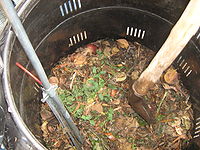
Ingredients Home compost barrel
in the Escuela Barreales,
Chile.
Composting organisms
require four equally
important things to work
effectively:
* Carbon — for energy;
the microbial oxidation
of carbon produces the
heat[citation needed].
o High carbon materials
tend to be brown and
dry.
* Nitrogen — to grow and
reproduce more organisms
to oxidize the carbon.
o High nitrogen
materials tend to be
green (or colorful, such
as fruits and
vegetables) and wet.
* Oxygen — for oxidizing
the carbon, the
decomposition process.
* Water — in the right
amounts to maintain
activity without causing
anaerobic conditions.
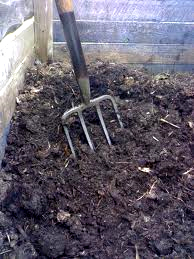
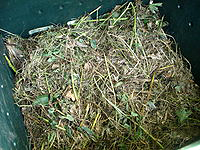
Materials in a
compost pile.
Certain ratios of these
materials will provide
beneficial bacteria with
the nutrients to work at
a rate that will heat up
the pile. In that
process much water will
be released as vapor
("steam"), and the
oxygen will be quickly
depleted, explaining the
need to actively manage
the pile. The hotter the
pile gets, the more
often added air and
water is necessary; the
air/water balance is
critical to maintaining
high temperatures until
the materials are broken
down. At the same time,
too much air or water
also slows the process,
as does too much carbon
(or too little
nitrogen).
The most efficient
composting occurs with a
carbon:nitrogen mix of
about 30 to 1. Nearly
all plant and animal
materials have both
carbon and nitrogen, but
amounts vary widely,
with characteristics
noted above (dry/wet,
brown/green).[5] Fresh
grass clippings have an
average ratio of about
15 to 1 and dry autumn
leaves about 50 to 1
depending on species.
Mixing equal parts by
volume approximates the
ideal C:N range. Few
individual situations
will provide the ideal
mix of materials at any
point in time - in this
respect, home composting
is like horseshoes,
perfect is great, but
close still works.
Observation of amounts,
and consideration of
different materials[6]
as a pile is built over
time, can quickly
achieve a workable
technique for the
individual situation.
Uses
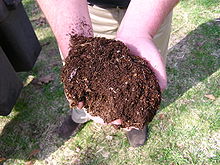
Compost is generally
recommended as an
additive to soil, or
other matrices such as
coir and peat, as a
tilth improver,
supplying humus and
nutrients. It provides a
rich growing medium, or
a porous, absorbent
material that holds
moisture and soluble
minerals, providing the
support and nutrients in
which plants can
flourish, although it is
rarely used alone, being
primarily mixed with
soil, sand, grit, bark
chips, vermiculite,
perlite, or clay
granules to produce
loam.
Generally, direct
seeding into a compost
is not recommended due
to the speed with which
it may dry and the
possible presence of
phytotoxins which may
inhibit
germination,[10][11][12]
and the possible tie up
of nitrogen by
incompletely decomposed
lignin.[13] It is very
common to see blends of
20–30% compost used for
transplanting seedlings
at cotyledon stage or
later.
Destroying pathogens,
seeds, or unwanted
plants
Composting can destroy
pathogens or unwanted
seeds. Unwanted living
plants
(or
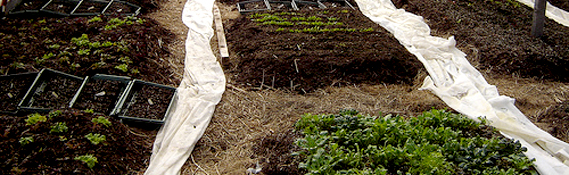
weeds) can be destroyed
by covering with
mulch/compost.
The "microbial
pesticides" in compost
may include thermophiles
and mesophiles, however
certain composting
detritivores such as
black soldier fly larvae
and redworms, also
reduce many pathogens.
Thermophilic
(high-temperature)
composting is well known
to destroy many seeds
and nearly all types of
pathogens (exceptions
may include prions).
However, thermophilic
composting requires a
fair amount of material,
around a cubic meter.
The sanitizing qualities
of (thermophilic)
composting are desirable
where there is a high
likelihood of pathogens,
such as with manure.
Applications include
humanure composting or
the deep litter
technique.
Types
Compost tea
Compost tea is a liquid
solution or suspension
made by steeping compost
in water. It is used as
both a fertilizer and in
attempts to prevent
plant diseases.[14] The
liquid is applied as a
spray to non-edible
plant parts, or as a
soil-drench (root dip),
such as seedlings, or as
a surface spray to
reduce incidence of
harmful phytopathogenic
fungi in the
phyllosphere.
Vermicompost is the
product of composting
utilizing various
species of worms,
usually red wigglers,
white worms, and
earthworms to create a
heterogeneous mixture of
decomposing vegetable or
food waste, bedding
materials, and vermicast.
Vermicast, also known as
worm castings, worm
humus or worm manure, is
the end-product of the
breakdown of organic
matter by species of
earthworm.
The earthworm species
(or composting worms)
most often used are Red
Wigglers (Eisenia
foetida or Eisenia
andrei), though European
nightcrawlers (Eisenia
hortensis) could also be
used. Users refer to
European nightcrawlers
by a variety of other
names, including
dendrobaenas, dendras,
and Belgian
nightcrawlers.
Containing water-soluble
nutrients, vermicompost
is a nutrient-rich
organic fertilizer and
soil conditioner.
Bokashi compost
Inside a recently
started Bokashi bin. The
aerated base is just
visible through the
food
scraps and Bokashi bran.
Bokashi is a method of
intensive composting. It
can use an aerobic or
anaerobic inoculation to
produce the compost.
Once a starter culture
is made, it can be used
to extend the culture
indefinitely, like
yogurt culture. Since
the popular introduction
of effective
microorganisms (EM),
Bokashi is commonly made
with only molasses,
water, EM, and wheat
bran.
In home composting
applications, kitchen
waste is placed into a
container which can be
sealed with an air tight
lid. These scraps are
then inoculated with a
Bokashi EM mix. This
usually takes the form
of a carrier, such as
rice hulls, wheat bran
or saw dust, that has
been inoculated with
composting
micro-organisms. The EM
are natural lactic acid
bacteria, yeast, and
phototrophic bacteria
that act as a microbe
community within the
kitchen scraps,
fermenting and
accelerating breakdown
of the organic matter.
The user would place
alternating layers of
food scraps and Bokashi
mix until the container
is full.







 Mexico
and supported the
country 1950-1958 to set
up a large humus
organization in the
fight against erosion
and soil degradation. In
the English-speaking
world it was Sir Albert
Howard who worked
extensively in India on
sustainable practices
and Lady Eve Balfour who
was a huge proponent of
composting. Composting
was imported to America
by various followers of
these early European
movements in the form of
persons such as J.I.
Rodale (founder of
Rodale Organic
Gardening), E.E.
Pfeiffer (who developed
scientific practices in
biodynamic farming),
Paul Keene (founder of
Walnut Acres in
Pennsylvania), and Scott
and Helen Nearing (who
inspired the
back-to-land movement of
the 1960s).
Coincidentally, some of
these personages met
briefly in India - all
were quite influential
in the U.S. from the
1960s into the 1980s.
Mexico
and supported the
country 1950-1958 to set
up a large humus
organization in the
fight against erosion
and soil degradation. In
the English-speaking
world it was Sir Albert
Howard who worked
extensively in India on
sustainable practices
and Lady Eve Balfour who
was a huge proponent of
composting. Composting
was imported to America
by various followers of
these early European
movements in the form of
persons such as J.I.
Rodale (founder of
Rodale Organic
Gardening), E.E.
Pfeiffer (who developed
scientific practices in
biodynamic farming),
Paul Keene (founder of
Walnut Acres in
Pennsylvania), and Scott
and Helen Nearing (who
inspired the
back-to-land movement of
the 1960s).
Coincidentally, some of
these personages met
briefly in India - all
were quite influential
in the U.S. from the
1960s into the 1980s.
 (or
weeds) can be destroyed
by covering with
mulch/compost.
(or
weeds) can be destroyed
by covering with
mulch/compost.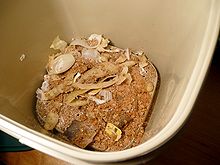 food
scraps and Bokashi bran.
food
scraps and Bokashi bran.

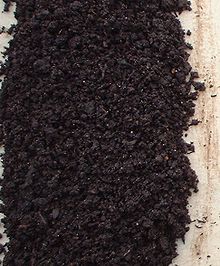
 ©
2008, www.tajagroproducts.com All rights reserved.
©
2008, www.tajagroproducts.com All rights reserved.