Country Profiles FMCG
Industries
With more than 1,000 insight-rich pages covering 81
countries and territories, Country Profiles offer
current and comprehensive business information, from
local laws and taxes to political and market
conditions Make them part of your smart trade
discovery process.
Country profile:
Philippines
languages: Filipino, English
(both official)
President: Gloria Macapagal Arroyo
Republic of the Philippines
religion: Christianity
Agro-Industry Development
Agriculture :
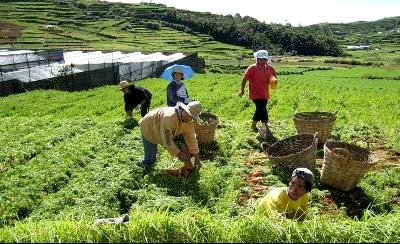
The Philippines is still primarily an
agricultural country despite the plan to make it
an industrialized economy by 2000. Most citizens
still live in rural areas and support themselves
through agriculture. The country's agriculture
sector is made up of 4 sub-sectors: farming,
fisheries, livestock, and forestry (the latter 2
sectors are very small), which together employ
39.8 percent of the labor force and contribute
20 percent of GDP.
The country's main agricultural crops are rice,
corn, coconut, sugarcane, bananas, pineapple,
coffee, mangoes, tobacco, and abaca (a
banana-like plant). Secondary crops include
peanut, cassava, camote (a type of rootcrop),
garlic, onion, cabbage, eggplant, calamansi (a
variety of lemon), rubber, and cotton. The year
1998 was a bad year for agriculture because of
adverse weather conditions. Sector output shrank
by 8.3 percent, but it posted growth the
following year. Yet, hog farming and commercial
fishing posted declines in their gross revenues
in 1999. The sector is burdened with low
productivity for most of its crops.
The Philippines exports its agricultural
products around the world, including the United
States, Japan, Europe, and ASEAN countries
(members of the Association of Southeast Asian
Nations). Major export products are coconut oil
and other coconut products, fruits and
vegetables, bananas, and prawns (a type of
shrimp). Other exports include the Cavendish
banana, Cayenne pineapple, tuna, seaweed, and
carrageenan.
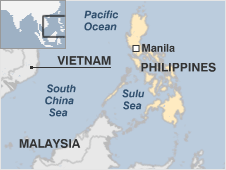
More than 7,000 islands make up the Philippines, but the bulk of its fast-growing population lives on just 11 of them.
Much of the country is mountainous and prone to earthquakes and eruptions from around 20 active volcanoes. It is often buffeted by typhoons and other storms.
Two presidents of the Philippines were forced from office by "people power" in the space of 15 years.
The Philippines - a Spanish colony for more than three centuries and named after a 16th century Spanish king - was taken over by the US in the early 20th century after a protracted rebellion against rule from Madrid. Spanish and US influences remain strong, especially in terms of language, religion and government.
Self-rule in 1935 was followed by full independence in 1946 under a US-style constitution. President Ferdinand Marcos, a close ally of the US, imposed martial law in the early 1970s but was forced to step down in 1986 after mass demonstrations cost him the support of the armed forces.
Although the country has remained a democracy it has enjoyed little stability. President Joseph Estrada was forced out of office in 2001 after months of protests at his corrupt rule, and there have been a number of coup attempts against his successor, Gloria Arroyo.
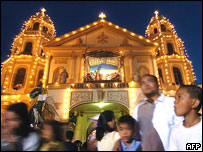
The church's influence is strong in Asia's largest Catholic nation
On the southern island of Mindanao, rebels have been fighting for a separate Islamic state within the mainly-Catholic country. The decades-long conflict has claimed more than 120,000 lives. Sporadic violence has continued despite a 2003 ceasefire and peace talks.
The Abu Sayyaf group on the island of Jolo has a history of violence towards hostages, and the government has declared all-out war on it over its alliance with al-Qaeda.
Although it once boasted one of the region's best-performing economies, the Philippines is saddled with a large national debt and tens of millions of people live in poverty. The economy is heavily dependent on the billions of dollars sent home each year by the huge Filipino overseas workforce.
The Philippines has the highest birth rate in Asia, and forecasters say the population could double within three decades.
Governments generally avoid taking strong measures to curb the birth rate for fear of antagonising the Catholic Church, which opposes artificial methods of contraception.
Gloria Arroyo's efforts to tackle corruption and to focus on economic reform have been undermined by a string of scandals.
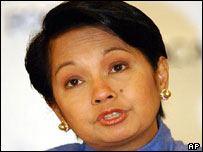
President Arroyo: Her first term brought mixed results
The president won a second six-year term in June 2004, defeating her main rival, the film star Fernando Poe Junior.
But a year later her popularity rating had fallen to a record low amid opposition claims that she cheated in the 2004 elections. Opponents also levelled corruption allegations against her husband and other family members.
She apologised to the nation for talking to an election official about her hopes for victory in the run-up to the 2004 poll, but denied any wrongdoing. Two subsequent attempts to impeach her have failed.
Mrs Arroyo faces the challenge of delivering on her promises to create jobs and to improve living standards. Social and economic reforms introduced during her first term did little to ease poverty and the country's debt burden.
She advocates constitutional reform, proposing to swap the country's US-style presidential system for a parliamentary government.
She has taken a strong line on law and order and allied herself closely to US President George W Bush's "war on terror".
Gloria Arroyo comes from the political elite in the Philippines. She is an economist whose father was president in the early 1960s.
She was elevated from vice president to president in 2001 after protests led to the ousting of her predecessor, Joseph Estrada. In 2003 she survived an attempt by military mutineers to unseat her.
She is keen to emphasise her Christian faith. Observers contrasted her approach with the hard-drinking lifestyle favoured by President Estrada.
The Philippines has a two-house legislature - the Congress - which comprises a House of Representatives, with up to 250 members, and a 24-member Senate.
Powerful commercial interests control or influence much of the media.
The lively TV scene is dominated by the free-to-air networks ABS-CBN and GMA, which attract the lion's share of viewing. Some Manila-based networks broadcast in local languages. The country has a well-developed cable TV system.
Films, comedies and entertainment programmes attract the largest audiences. Many TV broadcasters also operate radio networks. There are more than 700 FM and mediumwave (AM) radio stations, most of them commercial.
Press freedom is guaranteed under the 1987 constitution. The private press is vigorous, with tabloid newspapers being prone to sensationalism.
However, violence against media workers is a problem. Reporters Without Borders noted in 2008 that "constant threats and physical attacks make some regions, particularly Mindanao island, dangerous areas".
By 2007 there were 14 million internet users (ITU).




 Country profile:






 ©
2008, www.tajagroproducts.com All rights reserved.
©
2008, www.tajagroproducts.com All rights reserved.