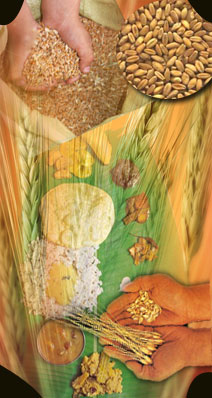
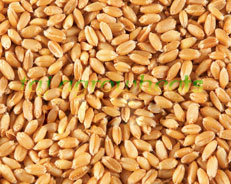
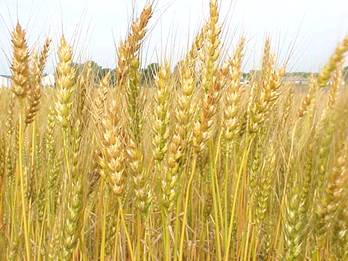
Wheat is a type of
grass grown all over the world
for its highly nutritious and
useful grain. It is one of the
top three most produced crops in
the world, along with corn and
rice.
Wheat has been
cultivated for over 10,000 years
and probably originates in the
Fertile Crescent, along with
other staple crops. A wide range
of
wheat products are
made by humans, including most
famously flour, which is made
from the grain itself.
Today,
wheat is a grass
that grows between two and four
feet (½ to 1 ¼ meters) tall. The
physical appearance of the grain
is familiar to most consumers,
with a long stalk that
terminates in a tightly formed
cluster of plump kernels
enclosed by a beard of bristly
spikes.
Wheat is an
annual, which means that at the
end of each year, fields must be
plowed and prepared again to
grow the grass.
Wheat is very important food
Wheat
is the dominant grain of world
commerce. It is easily
transported and stored and it is
used to produce a large variety
of foods that include many kinds
and types of breads, cakes,
noodles, crackers, breakfast
foods, biscuits, cookies, and
confectionary items.
Wheat is the staple food of
millions of people. It is also
an important part of the daily
diet of many millions more. Only
rice challenges wheat for the
title of most important food
grain in the world.
The world wheat market is
enormous. Annual global wheat
consumption is in excess of 550
million tonnes (20 billion
bushels). Farmers of the world
produce almost 20 times as much
wheat as is produced in Canada
to satisfy this growing
appetite.
World wheat production increased
at a rate of 3.3 percent per
year between 1949 and 1978
.Increases at the start of this
period were due to both an
expansion of production area and
increased per acre yields.
However, starting in the 1960's,
increased yields from improved
varieties and a greatly expanded
use of irrigation, pesticides,
and fertilizers took on greater
importance in sustaining the
high rate of growth in world
wheat production. In fact, the
impact of new production
technologies was so significant
that their widespread adoption
during this period became known
as the "green revolution".
The
Varieties of Wheat
The number of wheat varieties
exceeds any other seed-bearing
plant. There are two general
types of wheat -- Winter and
Spring -- reflecting the time of
year the seed is planted.
Foods made with wheat are a
major part of the diet for over
a third of the world's people.
In fact, wheat can be found in
some form at almost every meal.
Breads, cookies, cakes,
crackers, macaroni, spaghetti,
and other forms of pasta are
made from flour, which is ground
up kernels of wheat.
During the 1900's, scientists
developed many new kinds of
wheat. These new types of wheat
can produce large amounts of
grain that can resist cold,
disease, insects, and other crop
threats. As a result, wheat
production around the world has
risen dramatically.
How
Wheat Is Grown
Wheat grows in a variety of
climates and
soil.
Suitable weather and proper soil
are needed to produce a healthy
wheat crop. Wheat farmers must
use high-quality seed that is
free from disease to produce
high yields. Farmers also must
plant and
harvest
the wheat at the
correct time. They must protect
the growing crop from damage
caused by disease and pests.
Wheat likes to be grown in
fairly dry and mild climates.
Weather conditions influence
when wheat is planted. Winter
wheat is planted from September
to November. It is planted a few
inches deep in narrow channels
called furrows. Snow fills the
furrows and protects the plants
from the cold. Spring wheat is
planted from early March to
mid-April. It has a shorter
growing period than winter
wheat.
THE AGRICULTURAL AND PROCESSED FOOD PRODUCTS
EXPORT CESS ACT, 1985 NO. 3 OF 1986 PUBLISHED VIDE
NOTIFICATION NO. 3 DT. 8TH JANUARY 1986 HAS BEEN
REPEALED VIDE MINISTRY OF LAW AND JUSTICE NOTIFICATION
NO. 26 DT. 2ND JUNE 2006 UNDER THE CESS LAWS (REPEALING
AND AMENDING) ACT, 2006.